

Bounce House Anchoring in Acadiana: Stakes, Sandbags and Soft Louisiana Ground
When a delivery crew pulls up to your yard, the part of the job that decides whether your party is safe or scary takes about fifteen minutes and almost nobody watches it. Bounce house anchoring — driving the stakes, running the straps, tensioning every corner — is the single most important step in an inflatable setup, and it is the step that gets shortcut most often by budget operators and by families trying to set up a big-box unit themselves.
This guide walks through how inflatables are actually anchored, why soft, rain-soaked Acadiana ground changes the math, what happens on driveways and gravel where stakes will not go, and the questions you should ask before anyone unrolls vinyl in your yard. Whether you are in Lafayette, Youngsville, Maurice, Broussard, Abbeville, Carencro, Breaux Bridge, or Scott, the ground under your party has its own personality — and a good crew reads it before the blower ever turns on.
Why Anchoring Is the Whole Ballgame
An inflatable is, structurally speaking, a very large sail. It is light, it is tall, it has enormous surface area, and it is full of air. The only thing keeping it in your yard is the connection between its anchor points and the earth.
The U.S. Consumer Product Safety Commission is blunt about this. In its consumer guidance on inflatables, CPSC warns that if a bounce house is not properly secured to the ground, a gust of wind can send it airborne with children inside. Its published guidance also advises that inflatables should be properly staked and anchored on a flat, even surface, that manufacturer setup instructions should be followed, and that units should never be placed near tree branches, power lines, or fences.
That last point matters more in Acadiana than people expect. Our yards are full of live oaks, pecan trees, and low service drops. A unit that shifts three feet during a gust needs three feet of clearance it does not have.
How a Bounce House Is Actually Anchored
Commercial inflatables have sewn-in anchor points — usually D-rings or reinforced webbing loops — spaced around the base. A proper setup uses every one of them. CPSC’s guidance is to use every anchor point, every time, following the manufacturer’s method. Skipping the two in the back because they are near a flower bed is not a small shortcut; it changes how load transfers across the whole unit.
Ground Stakes
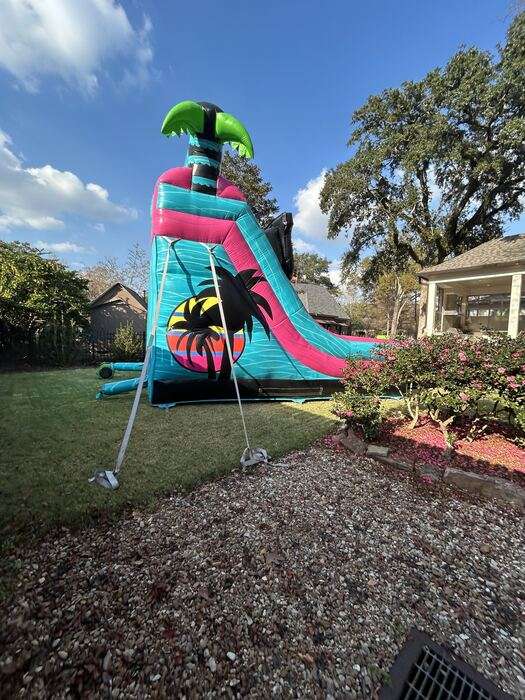
On grass, the standard is a long steel stake — commonly 18 inches or more — driven at an angle away from the unit so the pull of the strap works against the soil rather than lifting straight out. Short landscape staples and tent pegs are not equivalent. The holding power comes from length and angle, not from how hard someone hammers.
Straps then run from each anchor point down to a stake, and get tensioned so the base sits flat with no slack. Slack is what lets a unit rock and build momentum in a gust.
Sandbags and Ballast
When stakes cannot be used, weight replaces them. Sandbags or water ballast are secured to the same anchor points. Ballast is heavier, bulkier, and requires more of it than most people imagine — this is why hard-surface setups take longer and why crews ask about your surface when you book.
Soft Ground: The Acadiana Complication
Here is the thing nobody tells you. A stake in dry, packed soil and the same stake in saturated soil are two completely different fasteners.
South Louisiana yards sit on heavy clay that swells when wet, and we get rain in volume. After a few days of steady rain — or after a morning thunderstorm the day of your party — the top several inches of a lawn can turn to pudding. Stakes driven into that layer will hold far less than stakes driven into firm ground, because the soil around them simply moves.
- Wet yards need deeper stakes. A crew may go longer than usual, or add stakes, to reach firmer soil beneath the soaked layer.
- Standing water is a stop sign. Ponding around the setup area is a problem for anchoring and for the electrical side of the setup.
- Freshly laid sod is the worst case. New sod is not rooted. Stakes pull through it. If your yard was sodded in the last few weeks, say so when you book.
- Recently tilled or filled ground behaves the same way. Loose fill has almost no holding strength until it settles and compacts.
This is also why a rain policy and an anchoring conversation are two halves of the same subject. If you want the full picture on weather calls, our bounce house rental rain policy guide covers how those decisions get made, and our post on bounce house safety in high winds covers the wind side.
What Is Under Your Yard: Sprinklers, Cables, and Why We Ask
Stakes go 18 inches or more into the ground. Plenty of things live at that depth.
Irrigation lines are the most common casualty at a backyard party — shallow poly tubing running along bed lines and property edges, invisible from the surface. Low-voltage landscape lighting wire is another. Neither is dangerous, but both are annoying and expensive to repair, and both are avoidable if you tell the crew where they run.
Utilities are the serious category. Louisiana has a free statewide locate service: Louisiana 811. Anyone disturbing soil — individuals or companies, hand tools or heavy equipment — can call 811 or 1-800-272-3020, or file a request online, and member utilities will mark their buried lines. The service is free, funded by its members, and Louisiana 811 asks for at least two full business days’ notice for a standard request.
For a typical backyard rental on an established lawn where the crew knows the property, this rarely comes into play. For a first-time setup on acreage, a new-construction lot, a church field, or anywhere you genuinely do not know what is buried, it is worth the phone call — and it costs nothing.
- Mark your sprinkler heads and valve boxes with flags before delivery day.
- Point out any low-voltage lighting runs, invisible pet fence wire, or French drains.
- Mention septic field lines — a drain field is not a place for stakes.
- If you have a well, know roughly where the line runs to the house.
Driveways, Patios, and Gravel: When Stakes Are Not an Option
You cannot stake concrete, and you should not try. Hard surfaces get sandbag or water ballast anchoring instead, tied to the same anchor points. It works, it is standard practice, and it takes longer to set up and break down.
Gravel and shell — common on rural properties around Maurice, Abbeville, and Breaux Bridge — are a middle case. Stakes may bite or may not, depending on depth and what is underneath, so crews often bring ballast as a backup.
A few practical notes for hard-surface setups: the surface should be reasonably level, free of sharp debris that can abrade vinyl, and clear of vehicle traffic for the whole rental window. We covered the details in our guide to bounce house setup on concrete, and if your yard is anything but flat, our post on sloped and uneven yards is the companion read.
What Good Anchoring Looks Like — A Homeowner’s Checklist
You do not need to be an expert. You need to know what a correct setup looks like so you can tell if something is off.
- Every anchor point is used. Walk the perimeter and look. Empty D-rings are a red flag.
- Straps are taut, not slack. A properly tensioned unit does not shift when you push on a wall.
- Stakes are angled away from the unit, driven flush, and not sitting proud where someone can trip on them.
- The base sits flat. Corners lifting off the ground mean tension is uneven.
- Blower hose is secure and the blower is on stable, dry footing away from any water play.
- Clearance overhead and to the sides — no branches, no wires, no fence within the unit’s reach if it shifts.
And one behavioral rule that matters as much as the hardware: nobody unstakes or repositions an inflatable mid-party. If it needs to move, the unit gets deflated first. Dragging a live inflatable across a lawn tears anchor points and defeats the whole system.
Anchoring at Schools, Churches, and Parks
Institutional venues add a layer. Sports fields often sit over irrigation. School courtyards and church parking lots are frequently hard surfaces requiring ballast. Public parks may restrict staking entirely to protect turf and buried infrastructure, and may require a permit.
If you are booking for a school event, a church event, or a corporate event, ask the facility two questions early: is staking permitted, and where do the irrigation and utility lines run? Getting that answer a week out is a five-minute conversation. Getting it on setup morning is a problem.
Frequently Asked Questions About Bounce House Anchoring
How deep do bounce house stakes go?
Commercial setups typically use steel stakes of 18 inches or longer, driven at an angle away from the unit. Exact length depends on the manufacturer’s instructions and on ground conditions — soft or saturated soil generally calls for longer stakes or additional anchor points.
Will stakes damage my lawn?
The holes are small and close up on their own within a week or two. Stakes will not damage established turf in any lasting way. Fresh sod is the exception — it has not rooted, so stakes can pull through and tear it. Let your rental company know if your lawn is new.
Can a bounce house be anchored on concrete or a driveway?
Yes, using sandbag or water ballast anchoring secured to the unit’s anchor points instead of stakes. It is standard practice for hard surfaces. Mention your surface when you book so the crew brings the right equipment and allows extra setup time.
What if it rains and my yard is soaked?
Saturated ground holds stakes less securely, so the crew may use longer or additional stakes to reach firmer soil. Standing water in the setup area is a genuine problem and may mean relocating the unit or rescheduling. Talk to your rental company as soon as the forecast turns.
Do I need to call 811 before a bounce house rental?
For a routine backyard setup on an established lawn, usually not. For acreage, new construction, a field, or anywhere you do not know what is buried, a free Louisiana 811 locate request is worth making — allow at least two full business days.
How much wind is too much for a bounce house?
CPSC guidance states that maximum wind speed should be no more than 15 to 25 mph when using a bounce house, and offers a simple field test: if the tops of the trees are swaying, it may be too windy. Anchoring is not a substitute for a wind call — it is what keeps the unit safe within acceptable conditions.
Can I move the bounce house after it is set up?
No. Never reposition a live inflatable. If it truly needs to move, it must be deflated, unanchored, relocated, and re-anchored from scratch. Call us at (337) 469-4669 rather than attempting it yourself.
Who does the anchoring — me or the rental company?
Your delivery crew does. That is part of what you are paying for with a full-service rental, and it is a meaningful difference between a professional company and a self-setup unit from a big-box store. More on what to expect on the day in our delivery and setup day guide.
What should I do to prepare my yard?
Mow a few days ahead, clear debris and pet waste, flag sprinkler heads and any buried lines you know about, unlock the gate, and make sure the crew has a clear path wide enough for the unit. Our yard prep guide has the full walkthrough.
Book an Inflatable That Gets Anchored Right
Anchoring is not glamorous and it never shows up in the party photos. It is also the reason a rental company exists — the crew brings the stakes, the ballast, the experience to read your ground, and the judgment to say “not here, let’s move it six feet” when that is the right call.
Browse our bounce houses, water slides, and obstacle courses, or head straight to booking to check availability for your date. Planning a birthday party? We deliver across Acadiana, including Lafayette and Maurice.
Questions about your yard, your driveway, or that patch that never quite dries out? Call (337) 469-4669 — we would rather talk it through before delivery day than improvise on it. You can also check our FAQs for quick answers.
References
- U.S. Consumer Product Safety Commission — Don’t Get Swept Away: CPSC Reminds Consumers to Be Grounded in Safety When Using Bounce Houses
- Louisiana 811 — Free locate requests before you dig