

Can You Set Up a Bounce House on a Sloped or Uneven Yard in Acadiana?
If you’ve ever looked out at your backyard and wondered whether it’s flat enough for a party, you’re not alone. Setting up a bounce house on a sloped or uneven yard is one of the most common questions we hear from parents across Acadiana, and the honest answer is that it depends on how much slope you’re working with. A gentle slant is usually no problem at all, but a steep hill or a deeply rutted lawn can turn a fun rental into a safety risk. In this guide you’ll learn how much slope is too much, why level ground matters, what kinds of ground our team can safely set up on, and what to do if your yard in Lafayette, Youngsville, or Maurice isn’t perfectly flat. By the end you’ll know exactly how to check your space before you book, and how Patriot Jumps helps you find the safest spot for the party.
Does Your Yard Have to Be Perfectly Flat?
Good news first: your yard does not have to be a perfectly level slab to host a bounce house. Almost no real Acadiana backyard is truly flat, and we set up on gently sloping and slightly uneven grass all the time. What matters is the degree of the slope and the condition of the ground. A yard with a slight, gradual grade that you’d barely notice while walking is typically fine. A yard where a ball would visibly roll downhill on its own, or where one corner sits noticeably lower than the other, is where we start looking for a better spot or a different plan.
How Much Slope Is Too Much?
There’s no need to break out a laser level, but a simple guideline helps. A very slight slope can usually be worked with when the unit is anchored properly. A moderate hill is a judgment call and often means choosing a smaller unit or a different area of the yard. A steep hill is a no-go, because the inflatable can shift, kids slide toward the low end, and the anchoring loses its grip. Here are easy ways to eyeball it before you book:
- The ball test: set a ball down in the middle of the space. If it sits still or drifts slowly, you’re in good shape. If it rolls away on its own, the slope is significant.
- The corner check: stand at each corner of the setup area. If one corner is clearly lower than the others, note how big the drop looks.
- The walk test: walk the area. If you can feel yourself going noticeably uphill or downhill, our team will want to see photos first.
When in doubt, snap a few photos of the space and text or call us at (337) 469-4669. We’d rather help you find the right spot than have a unit that won’t sit safely.
Why Level Ground Matters So Much
Level ground isn’t just about comfort, it’s a real safety issue. On a slope, kids naturally drift and pile up at the low end, which raises the chance of bumps and collisions. A tilted unit also puts uneven stress on the seams and the blower. Most importantly, anchoring works best on firm, level ground: stakes hold better and the unit stays put. The U.S. Consumer Product Safety Commission stresses that bounce houses should be set up on an even surface and anchored properly, and shut down in high winds. A peer-reviewed study in the Bulletin of the American Meteorological Society documented dozens of wind-related bounce house incidents, a reminder that a solid, level base and correct anchoring genuinely matter. That’s why our crew evaluates the ground before every setup.
Grass, Bumpy, or Soft Ground: What We Can Work With
Gentle Slopes
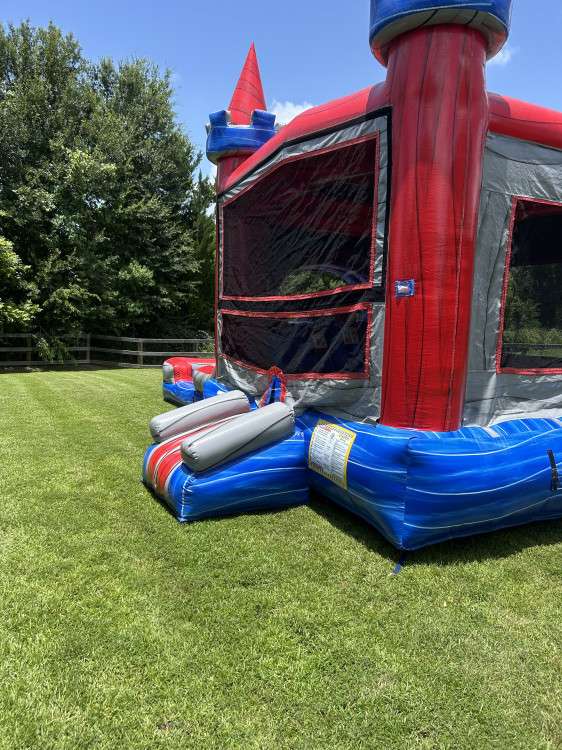
Slight, gradual slopes are the most common yard type in Acadiana, and they’re usually workable. We orient and anchor the unit to account for the grade, and in many cases you’d never know the yard wasn’t perfectly flat once the party is going.
Bumpy or Uneven Lawns
Small dips, mole runs, and lumpy spots are fine as long as the overall area is reasonably even. We’ll clear sticks, rocks, pinecones, and pet mess first, since debris under the vinyl floor is uncomfortable and can damage the unit. If your lawn has a big rut or a hidden hole, point it out so we can place the unit around it.
Soft, Soggy, or Freshly Watered Ground
Louisiana rain is a fact of life, and soft ground reduces how well stakes hold. If your yard has been soaked by recent storms or you run sprinklers the morning of the party, let us know. We may adjust the anchoring or suggest a firmer part of the yard.
What to Do If Your Yard Isn’t Ideal
A less-than-perfect yard rarely means you have to cancel the fun. You usually have great options:
- Pick the flattest area available. Front yard, side yard, or a leveled part of the back, we’ll help you choose.
- Use a hard surface. A driveway or patio can work with sandbag anchoring. See our guide on setting up on concrete and hard surfaces.
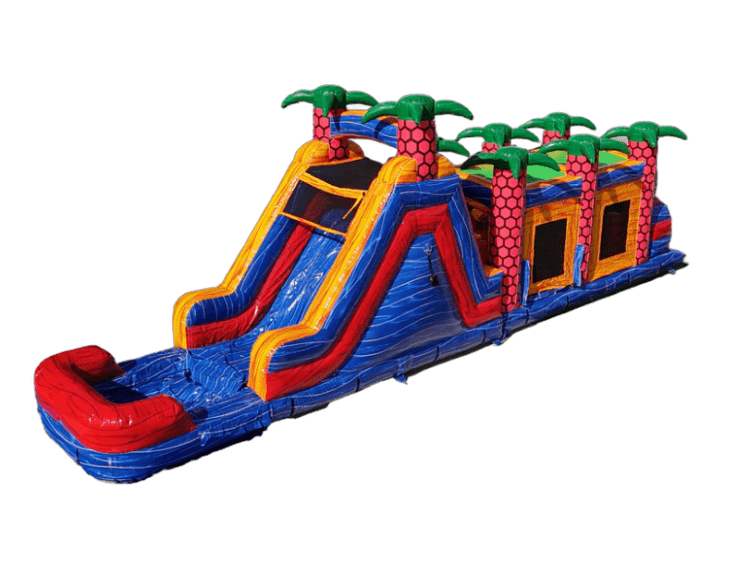
- Choose the right unit. A compact bounce house fits and anchors more easily on a tricky yard than a tall water slide or a long obstacle course.
- Consider a park or venue. A flat, open field can be perfect, just remember many public parks require permits and have their own rules.
How to Check Your Yard Before You Book
A quick walk-through saves everyone time on party day. Before you reserve, take a minute to:
- Measure the flattest area, allowing a few feet of clearance on all sides.
- Do the ball test and note any slope or low corners.
- Look for overhead power lines and tree branches.
- Clear debris and mark any sprinkler heads or septic lids.
- Confirm there’s a power outlet within about 100 feet, or ask us about a generator.
Our friendly FAQ page answers more of the practical questions, and you’re always welcome to send photos of your space so we can advise before you commit.
Serving Real Backyards All Over Acadiana
From the rolling lots around Lafayette and the newer subdivisions in Youngsville and Broussard to the country yards near Maurice, Abbeville, Carencro, Scott, and Breaux Bridge, we’ve set up on just about every kind of ground Acadiana has. No two yards are alike, and that local know-how is exactly why families trust us to make the call on what’s safe. Whether you’re planning a birthday party or a neighborhood get-together, we’ll help you set up somewhere everyone can bounce with confidence.
Frequently Asked Questions
Can a bounce house go on a sloped yard?
Yes, a gentle or slight slope is usually fine with proper anchoring. Steep hills are not safe, because the unit can shift and kids slide to the low end. If you’re unsure, send us a photo and we’ll let you know.
How flat does the ground need to be?
It doesn’t have to be perfectly level. As a rule of thumb, if a ball placed in the middle stays put or drifts slowly, the area is workable. If it rolls away on its own, we’ll look for a better spot.
Can you set up on a bumpy or uneven lawn?
Usually yes, as long as the overall area is reasonably even and free of big ruts, holes, rocks, and debris. We clear the surface before setup to protect the unit and keep kids comfortable.
What if my yard is soft or muddy from rain?
Soft ground holds stakes less securely, so let us know if your yard has been soaked recently. We may adjust anchoring or move to a firmer area. In wet weather we also monitor conditions closely for safety.
What if I don’t have a flat yard at all?
You still have options: a driveway or patio with sandbag anchoring, the flattest available area, a smaller unit, or a nearby park. Call us at (337) 469-4669 and we’ll help you find a safe solution.
Do you check the yard before setting up?
Always. Our crew evaluates the ground, slope, clearance, and anchoring options at delivery, and we’ll never set up a unit somewhere we don’t consider safe.
Ready to Book Your Acadiana Bounce House?
Don’t let an imperfect yard stop the party. Tell us about your space and we’ll help you pick the perfect unit and the safest spot to set it up. Book your bounce house or water slide online or call Patriot Jumps at (337) 469-4669 today, and let’s get the kids bouncing in Lafayette, Youngsville, Maurice, and all across Acadiana.
References
- U.S. Consumer Product Safety Commission, “Don’t Get Swept Away; CPSC Reminds Consumers to Be Grounded in Safety When Using Bounce Houses”: cpsc.gov
- Knox, J. A., et al. (2022), “Wind-Related Bounce House Incidents,” Bulletin of the American Meteorological Society: journals.ametsoc.org