

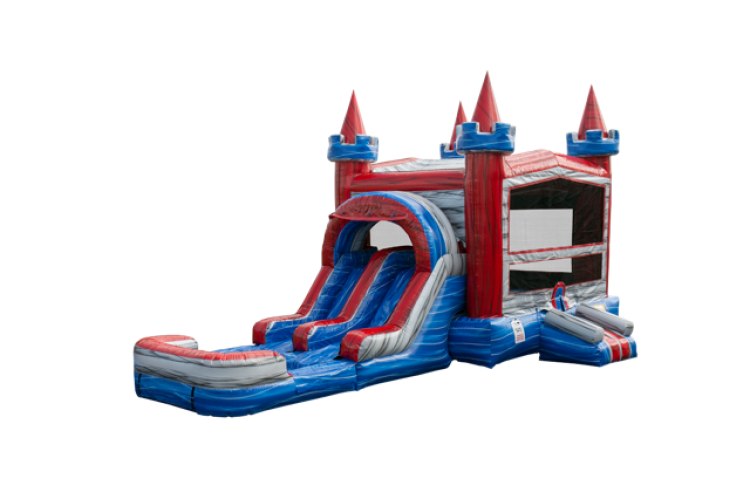

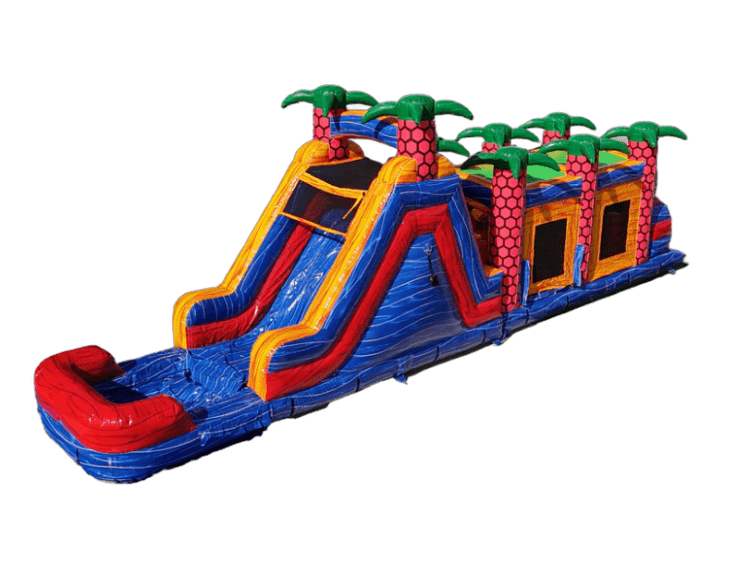
Does a Bounce House or Water Slide Run Up Your Utility Bill? Real Numbers for Acadiana Parties
You have the date picked, the cake ordered and the guest list texted out. Then a practical thought sneaks in: does a bounce house use a lot of electricity? And if you are adding a water slide, how many gallons is that hose going to burn through in an afternoon? It is a fair question, and almost nobody answers it with real numbers. The short version is that the bounce house electricity cost for a typical backyard party in Acadiana runs about a dollar, and the water is the part actually worth planning around. In this guide we break down exactly what the blower draws, how to estimate your own water use with a number off your own bill, and four easy ways to keep both numbers small. Whether you are in Lafayette, Youngsville, Maurice or Abbeville, you will finish this page able to budget the utility side of your party down to a few dollars.
The Short Answer
For a standard six-hour rental: the blower on a bounce house rental will add roughly one dollar to your power bill. A water slide rental adds that same dollar plus whatever water you run through the hose, which is the bigger line item and the one you can actually control. Neither one is going to wreck your budget. Both are worth understanding so you are not guessing.
What the Blower Actually Costs to Run
Every inflatable we deliver stays up because a blower pushes air into it continuously. It is not like an air mattress that gets pumped once and unplugged. The blower runs the entire time kids are playing, which is exactly why our team tells you never to unplug it mid-party.
Most residential-size units run on a single blower in the 1 to 1.5 horsepower range. While it is running, that draws somewhere around 1,000 to 1,500 watts, or roughly 1 to 1.5 kilowatts. To put that in household terms, it is in the same neighborhood as a hair dryer or a countertop microwave, except it runs steadily instead of in bursts. If you want your exact number, look at the data plate on the blower housing when we set up. It will list the amps and volts.
Now the arithmetic. Say your unit pulls 1.2 kilowatts and runs for six hours:
- 1.2 kW × 6 hours = 7.2 kilowatt-hours
- At about 15 cents per kilowatt-hour, that is roughly $1.08
- Run it nine hours instead of six and you are still under $1.70
For context, the U.S. Energy Information Administration reported a national residential average of 18.34 cents per kilowatt-hour in June 2026, and Louisiana households have historically paid below that national average. Use the per-kilowatt-hour rate printed on your own Entergy, SLEMCO or LUS bill for a precise figure. Either way, the answer lands somewhere between “a dollar” and “a dollar and change.”
Two units means two blowers, so double it. Even a big obstacle course rental with two blowers running all day is still a couple of dollars of electricity.
Water Slides: The Number That Actually Matters
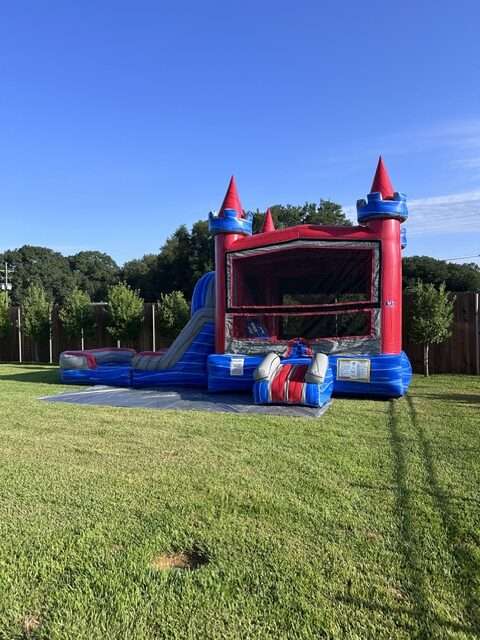
This is where people are usually surprised, and not in the direction they expect. A water slide does not need a firehose. It needs a steady trickle down the slide surface and into the splash pool, and that is it. The mistake we see is homeowners cranking the spigot wide open and leaving it there for six hours.
A garden hose at full blast moves a lot more water than most people picture. Washington State University Extension publishes a free garden hose flow calculator where you can plug in your hose diameter, length and pressure. A common 5/8-inch, 50-foot hose at normal household pressure lands somewhere in the 8 to 17 gallons-per-minute range wide open. At just 10 gallons a minute for six straight hours, that is 3,600 gallons.
Throttled back to the trickle a slide actually needs — call it 3 gallons a minute — the same six hours is about 1,080 gallons. Same party, roughly a third of the water.
To turn gallons into dollars, grab your water bill and find the rate per 1,000 gallons. Most Acadiana utilities and rural water systems bill that way, and remember that sewer charges are often tied to water usage too. As an example, if your combined water and sewer rate came to $6 per 1,000 gallons, that 1,080-gallon party costs about $6.50, while the wide-open 3,600-gallon version costs closer to $22. Your rate will be different — that is the point. Plug in your own.
If you are on a well out toward Maurice or Abbeville, you are paying in pump electricity rather than a metered rate, but the same logic applies: less flow, less cost.
Four Easy Ways to Keep Both Numbers Down
- Throttle the hose. Open the spigot until the slide surface is slick and the pool is topped off, then stop. More water does not make the slide faster.
- Run wet only while kids are actually on it. During cake, presents or a lunch break, shut the water off. The blower stays on; the hose does not need to.
- Book the hours you will actually use. A four-hour block for a toddler party beats an eight-hour block nobody uses after hour three. Our FAQs page covers how our rental windows work.
- Consider going dry. Once the mornings cool off in October, a dry unit is often the better call anyway — and your water cost drops to zero.
What This Means for Your Party Budget
Add it up for a typical Saturday birthday party in Broussard or Carencro with one water slide running six hours on a sensibly throttled hose: about a dollar of electricity and somewhere around five to ten dollars of water. Under fifteen dollars, all in.
That is less than the ice and drinks. We mention it because parents ask, and because a real number beats a vague worry. It is also worth knowing if you are hosting at a facility rather than a house — for school events and church events, utilities are generally the venue’s cost, not yours, but the facility manager will still want to know the blower draws about as much as a microwave and needs its own dedicated outlet.
One thing that is not optional: the blower needs a proper grounded outlet on a circuit that is not already loaded down. That is a safety issue, not a cost issue, and it is the single most common setup problem we run into in older homes around Scott and Breaux Bridge.
Frequently Asked Questions
Does a bounce house use a lot of electricity?
No. A typical blower draws about as much as a hair dryer, roughly 1 to 1.5 kilowatts, and a six-hour rental works out to around a dollar on your power bill.
Can I unplug the blower to save money?
Never while anyone is in or near the unit. The inflatable deflates within seconds. The savings are pennies and the risk is real — always clear the unit completely before the blower goes off.
How much water does a water slide rental use?
It depends entirely on how far you open the spigot. A wide-open hose can move thousands of gallons over an afternoon; a properly throttled one running only while kids are sliding is often closer to 1,000 gallons.
Do I need a dedicated outlet?
Yes. Each blower should have its own grounded outlet on a circuit that is not already running a window unit, freezer or power tools. Sharing a circuit is the fastest way to trip a breaker mid-party.
What if my yard has no outdoor outlet?
We can bring a generator. That shifts the cost from your power bill to a flat rental fee, and it is the standard solution for park pavilions and country properties around Maurice and Abbeville.
Does running it wet cost more than dry?
The electricity is identical — same blower either way. The only difference is the water, which is why the wet-versus-dry decision is really a comfort and weather decision, not a budget one.
Will the water kill my grass?
A few hours of water on Louisiana turf in warm weather generally will not. The bigger risk is the shaded footprint under the unit itself, which is why we set most units on a tarp.
Is water use included in the rental price?
When we set up at your home, you supply the water and power from the house, so those show up on your own utility bill — which, as this page works out, is a few dollars. Everything else is covered in the rental.
Ready to Book Your Party?
Now that the utility math is off your list, let’s get your date on the calendar. Patriot Jumps delivers clean, safety-inspected bounce houses, water slides and obstacle courses across Acadiana — Lafayette, Maurice, Youngsville, Broussard, Abbeville, Carencro, Scott and Breaux Bridge.
Check availability and book online, or call us at (337) 469-4669 and we will walk you through which unit fits your yard, your outlet situation and your budget.
References
- U.S. Energy Information Administration — Electricity Monthly Update (average residential revenue per kilowatt-hour)
- Washington State University Extension — Garden Hose Flow Rate and Time Calculator