

What to Do If Your Bounce House Loses Power Mid-Party
The music is going, the cake is out, and eight kids are mid-jump when the blower coughs and stops. The walls start to sag. If your bounce house loses power during a party, the first thirty seconds matter more than anything else that happens that afternoon — and the good news is that a calm adult with a plan handles it easily. Inflatables are built to sink slowly, not to drop, which gives you real time to work with.
September in Acadiana is exactly when this comes up. Pop-up thunderstorms roll across Lafayette and Youngsville most afternoons, breakers trip on hot circuits already carrying a snow-cone machine and a crockpot, and extension cords get walked out of the wall by kids running the perimeter. Below is what actually happens when the air stops, how to clear a unit safely, how to get it running again, and when the right answer is to leave it down and move the party inside.
Why Bounce Houses Lose Power in Acadiana
A bounce house is a “constant air” device. A blower runs the entire time the unit is in use, pushing far more air in than leaks out. Cut the power to that blower and the unit begins settling. In our service area, the cause is almost always one of these:
- Afternoon storms and utility flickers. Late-summer thunderstorms around Broussard, Maurice and Abbeville knock power out for anything from ten seconds to two hours.
- A tripped breaker. Blowers pull real amperage. Put one on the same exterior circuit as a fryer, a fridge in the garage, or a second inflatable and the breaker eventually says no.
- An unplugged or kicked-loose cord. The single most common cause, and the easiest to fix.
- A disconnected blower tube. The tube can work its way loose from the intake sleeve if the strap or tie wasn’t re-cinched.
- Generator problems. If you are running on a generator at a park or a field, it may simply be out of fuel.
Knowing which one you are dealing with takes about fifteen seconds — but only after the kids are out.
What Actually Happens When the Blower Stops
This is the part that surprises first-time renters: nothing dramatic. A commercial inflatable does not pop or collapse. Air bleeds out through the seams and the mesh gradually, and a full-size unit takes well over a minute to go soft enough to matter. Walls lean inward first, then the floor loses its bounce, then the taller features settle.
That slow deflation is a safety feature, and it is why panic is the real hazard here. Kids who scramble, jump, or try to climb a sagging wall get hurt far more often than kids who are walked out calmly. Your job is to be boring and clear.
The Five-Step Evacuation
Practice saying this out loud once before the party starts. It takes ten seconds and it makes the real thing effortless.
1. Say it loud and say it flat
“Everybody sit down.” Not “get out,” not “hurry.” Sitting drops their center of gravity and stops the running instantly. Kids mirror the energy of the adult talking to them — if you sound bored, they stay calm.
2. Send the biggest kids out first
This is counterintuitive, but older kids clear the exit fast and can then help from outside. A ten-year-old standing at the door pulling little ones out by the hand is genuinely useful.
3. Walk the little ones out yourself
Toddlers and preschoolers need a hand. Step up onto the deflating floor if you have to. Count heads as they come out and say the number out loud so a second adult can confirm it.
4. Check the corners and the slide
On a combo unit or a water slide, a child can be sitting at the top of the slide or tucked in a corner behind a column where you cannot see them from the door. Look before you walk away. Same goes for the tunnels on an obstacle course.
5. Move everyone well clear
Get the group fifteen or twenty feet back. If the outage is storm-related, get them inside the house — not under a carport or a pop-up tent.
Getting the Blower Running Again
Once the unit is empty, work the list in order. Do not let anyone back in while you troubleshoot.
- Look at the plug. Follow the cord from the blower to the outlet. A cord pulled halfway out looks plugged in from ten feet away.
- Check the GFCI. Most exterior outlets in Acadiana homes are GFCI-protected. Press the reset button on the outlet itself — and check the other outlets on that wall, since one GFCI often protects several.
- Check the breaker panel. Flip the tripped breaker fully off, then back on. If it trips again immediately, that circuit is overloaded — move the blower to a different circuit entirely, not just a different outlet.
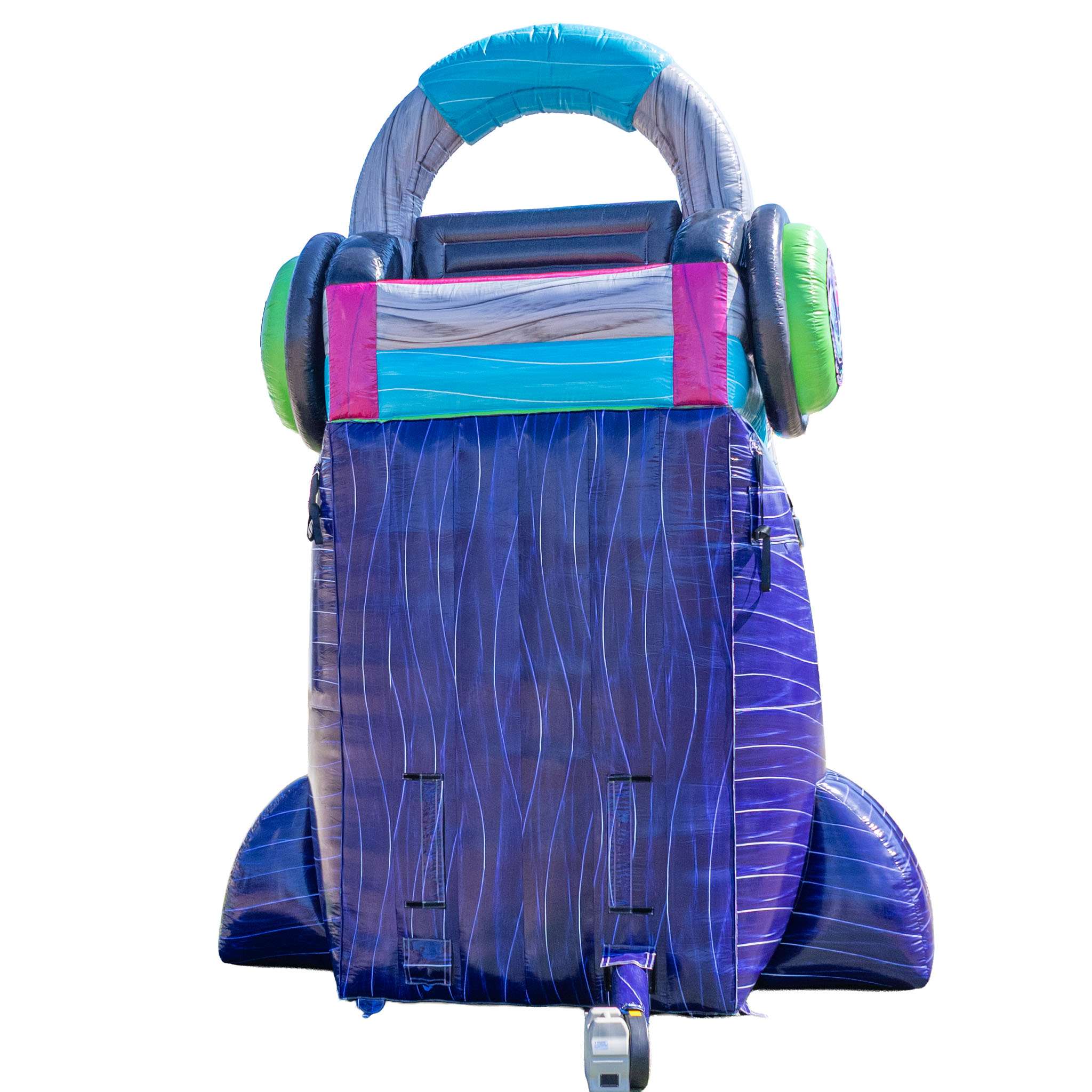
- Reseat the blower tube. Slide the sleeve back over the blower outlet and re-cinch the strap.
- Confirm the whole house is not out. If the microwave clock is dark too, it is a utility outage, not your setup.
If none of that brings it back, call us at (337) 469-4669. We would much rather drive out and look at it than have you guessing. Do not swap in your own blower or a shop fan — the unit is matched to its blower, and substituting one creates problems we cannot cover.
When You Should Leave It Down
Sometimes the right call is to stop for the day, and it is worth deciding that quickly rather than negotiating with a yard full of kids.
If the outage came with a storm, the inflatable stays down until the weather clears. The National Weather Service guidance for outdoor activities is blunt about this: if you hear thunder, the storm is close enough to be dangerous, and you wait a full 30 minutes after the last thunder before resuming. A deflated unit in the rain is not a problem — it dries. A yard full of kids under a thunderstorm is.
Wind is the other one. The CPSC advises against using inflatables in windy conditions, and a common rule of thumb is that if the tops of the trees are moving, it is too windy. Restoring power in gusty conditions just re-creates a hazard. When in doubt, leave it flat and let the kids do cake and presents instead.
Rain-outs are also why we keep a straightforward weather policy — you can read how we handle it on our FAQs page.
Preventing It in the First Place
Most power losses are avoidable with about five minutes of thought at setup:
- Give the blower its own circuit. Not its own outlet — its own circuit. Ask our driver which outlet they used and keep the fryer and the ice machine off it.
- Route the cord where nobody walks. Along a fence line or the base of the house, not across the path between the bounce house and the food table.
- Tape or stake the cord down at the outlet end so a tug does not unplug it.
- Assign one adult to the blower. Whoever is already watching the kids should know where it is and what it sounds like when it is running.
- Check the forecast the morning of. In Carencro, Breaux Bridge and Scott, a 3 p.m. storm is a September default, not a surprise. Front-load the bouncing to the early afternoon.
For bigger setups — a school event, a church festival, or a company picnic — talk to us in advance about power. Multiple units on one building’s exterior circuits is the classic way to trip a breaker twenty minutes into an event.
Frequently Asked Questions
How long does a bounce house take to deflate?
A full-size commercial unit sinks gradually rather than dropping. Walls soften first and the floor follows. You have time to walk children out at a normal pace — there is no need to rush anyone.
Is it dangerous if the bounce house deflates with kids inside?
The deflation itself is slow and the material is soft. The real risks are children panicking, running on an unstable floor, or getting disoriented under a sagging wall. Calm instructions and a head count handle all three.
Can I plug the blower into an extension cord?
Only the cord we supply. Blowers draw more current than a household extension cord is rated for, and an undersized cord is both a fire risk and a common cause of nuisance trips. If the outlet is too far away, tell us before delivery and we will bring the right solution.
What if the power goes out for hours?
If it is a utility outage with no restoration in sight, we will work with you on the rest of the rental. Call (337) 469-4669 as soon as you know — the earlier we hear from you, the more options we have.
Do you rent generators for parks and fields?
Yes. If your event is somewhere without a reliable outlet — a park in Lafayette, a field in Maurice, a property with no exterior power — let us know when you book and we will size the generator to your units.
Will rain hurt the inflatable?
A little rain will not damage a commercial unit, but wet vinyl is slick and rain usually travels with lightning and wind. We take kids off for the weather, not for the water.
Can we restart it ourselves after a storm passes?
Wait 30 minutes after the last thunder, confirm the wind has settled, then check that the unit is still properly staked before anyone gets back in. If anything looks like it shifted, call us first.
Does this happen often?
Honestly, no — and when it does, it is nearly always an unplugged cord. But knowing the plan takes five minutes and turns a scary moment into a non-event.
Book a Rental That Comes With a Plan
Every Patriot Jumps delivery includes a walkthrough — where the blower is, which outlet it is on, how to shut it down, and what to do if the weather turns. We set up across Acadiana: Lafayette, Youngsville, Maurice, Broussard, Abbeville, Carencro, Breaux Bridge and Scott.
Planning a birthday party this fall? Check availability and book online, or call us at (337) 469-4669 and we will walk you through power, placement and the weather plan before your date.
References
- U.S. Consumer Product Safety Commission — Amusement Ride Safety Bulletin: Inflatable Amusement Devices
- NOAA National Weather Service — Lightning Safety and Outdoor Sports Activities