

Will a Bounce House Kill Your Grass? Lawn Protection Tips for Acadiana Backyard Parties
Every party season we get the same question from a parent standing in a backyard in Youngsville or Broussard, looking at the one strip of lawn they have actually managed to keep green: “Is this thing going to kill my grass?” It is a fair question, and the honest answer is that bounce house grass damage is real, almost always temporary, and genuinely easy to prevent. A bounce house sitting on your lawn for five hours on a Saturday is a completely different situation from a tarp left down for a week. In this guide you will learn what actually stresses the turf underneath an inflatable, how long is genuinely too long, the five prep steps that protect your yard before we ever pull into the driveway, and exactly what to do the next morning to bring the color back. We will also cover the times when it makes more sense to skip the grass altogether.
What Actually Hurts the Grass (and What Does Not)
A bounce house does not poison your lawn. What it does is block three things grass needs: light, air exchange, and water. Almost everything else parents worry about matters far less than they expect.
The three real culprits
- Blocked sunlight. The turf under the vinyl floor stops photosynthesizing the moment we unroll the unit.
- Trapped heat and humidity. A tarp or an inflatable floor creates a greenhouse. The Sports Turf Managers Association notes that when air temperatures are above 60 degrees and it is bright and sunny, grass can cook under a tarp in a matter of hours. In an Acadiana September, that describes almost every afternoon.
- Standing water. This is the water slide one. A splash zone keeps a footprint of lawn saturated for hours, and soggy soil plus concentrated foot traffic is what actually produces ruts.
Weight is rarely the problem. Even a large combo spreads its load across a wide footprint, and St. Augustinegrass, which the LSU AgCenter calls one of the two most popular lawn grasses in Louisiana, tolerates some compaction and handles traffic wear fairly well.
How Long Is Too Long? The 24-Hour Number
Here is the figure worth remembering: about 24 hours. Turfgrass begins to yellow after roughly 24 to 48 hours under cover, and in warm weather professional field managers pull their tarps at the 24 to 36 hour mark specifically to let air and light back in. A standard four to six hour rental on a Saturday afternoon is nowhere near that threshold. Your grass will look flattened and maybe a shade paler where the unit sat, and within a few days it is usually impossible to tell where it was.
Where people get caught out is the all-day or weekend booking. If you have a unit down from Friday afternoon through Sunday for a Carencro family reunion, that is long enough to leave a visible rectangle. It is still very recoverable. You just want to plan for it rather than be surprised by it.
Why Acadiana Lawns Bounce Back Better Than Most
There is good news specific to where we live. The LSU AgCenter describes St. Augustinegrass as thriving along the Gulf South I-10 corridor, which runs straight through Lafayette, Scott, and Breaux Bridge, and notes that its vigorous stoloniferous growth will often repair damaged areas on its own when growing conditions are good and fertility is at least moderate. Stoloniferous simply means it spreads by above-ground runners. A thin or yellowed patch does not need to be reseeded; the surrounding grass creeps back over it.
September is a favorable month for that recovery. The turf is still actively growing, but the punishing peak-summer heat is starting to ease, so a stressed patch has both the growing season and gentler conditions working in its favor.
Five Things to Do Before We Arrive
- Mow a day or two early, not the morning of. Freshly cut grass is already stressed. Giving it 24 hours to settle before we cover it makes a real difference, and the AgCenter recommends keeping St. Augustine on the tall side at a 2.5 to 3.5 inch cut.
- Water deeply the day before, then stop. Well-hydrated grass handles a few dark hours far better than dry grass does. Do not water the morning of, though. A soggy yard rutted by a hand truck is a worse outcome than a slightly dry one.
- Pick the sunniest spot you are willing to give up. Turf in a shady corner is already running a light deficit and has much less margin to spare.
- Clear the footprint completely. Toys, hoses, dog bones, and fallen pecan branches all press into the turf under the unit and leave marks of their own.
- Tell us about irrigation or a septic field. We anchor with stakes, and we need to know where not to drive them. That one protects a good deal more than your grass.
Water Slides Need One Extra Decision
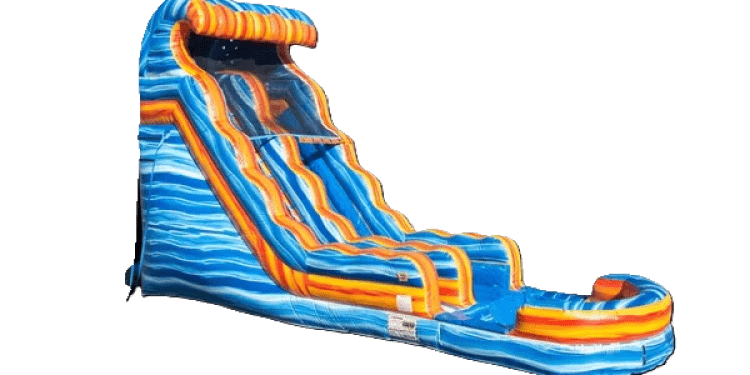
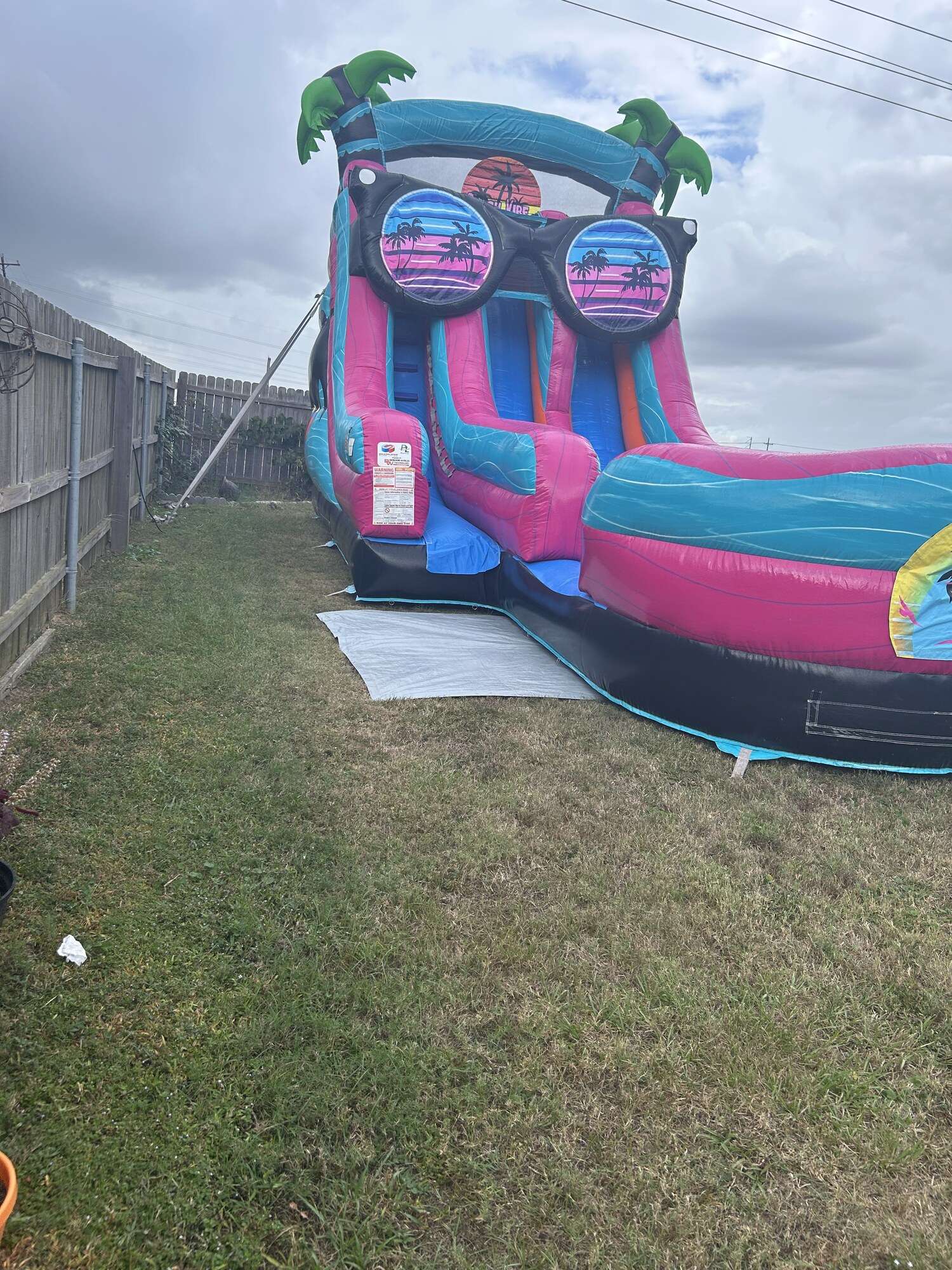
Water slides deserve a little extra thought because the damage pattern is different. The landing area gets saturated and takes the heaviest foot traffic, and that combination is what actually causes ruts rather than dead grass. Two easy fixes: aim the run-out toward a section of lawn you care less about or a spot that drains well, and encourage kids to exit to the side instead of wearing a single muddy path back to the ladder. If your yard in Abbeville or Maurice does not drain well anywhere, ask us about a driveway setup instead.
After Pickup: Bringing the Color Back
- Rake it upright. A leaf rake fluffs the flattened blades back up, and this alone fixes most of the “it looks dead” appearance.
- Water it that evening or the following morning.
- Skip the fertilizer for a week. Feeding stressed, shaded turf invites disease rather than speeding recovery.
- Stay off it for a few days so it is not fighting foot traffic while it recovers.
- Be patient. Discoloration from a normal rental typically grows out within a few days.
If two weeks later you still have a sharply defined dead rectangle, which is rare, that usually points to something that was already there. A pre-existing chinch bug or brown patch problem often only becomes visible once a section of lawn has been stressed.
When to Skip the Grass Entirely
Sometimes the lawn simply is not the right surface, and that is completely fine. Concrete driveways, pavilion slabs, gym floors, and church halls all work well. Rain in the forecast, a yard that stays soggy, freshly laid sod, or a lawn you have been nursing back from a rough summer are all good reasons to move the setup. We set up on hard surfaces regularly for school events, church events, and corporate events around Lafayette Parish and Vermilion Parish. The anchoring method changes to sandbags instead of stakes, but the party does not change at all.
Bounce House and Lawn Damage FAQs
Will a bounce house kill my grass in one day?
Almost never. A typical four to six hour rental is well inside the window turf can handle. You may see flattening and slight paling where the unit sat, and it normally grows out within a few days.
Does a water slide damage grass more than a bounce house?
Usually yes, but not for the reason people assume. The issue is not the water itself, it is the saturated landing zone combined with heavy foot traffic in one small area, which is what creates ruts and compaction.
Should I put a tarp under the bounce house to protect my lawn?
A ground cover protects the inflatable from your lawn, not the other way around. It does not help the grass, and a dark tarp actually accelerates yellowing because it blocks more light. We bring the appropriate ground protection with us, so there is nothing you need to buy.
How long does grass take to recover after a rental?
For a same-day rental, typically a few days. For an all-day or weekend booking, plan on a week or two of gradual green-up. St. Augustine spreads by runners, so it fills itself back in without reseeding.
Can you set up on my driveway or patio instead?
Yes, and we do it often. On hard surfaces we anchor with sandbags rather than stakes. Just let us know when you book so we bring the right equipment.
Do the anchor stakes damage my lawn or sprinkler lines?
The stake holes themselves are small and close up quickly. Sprinkler lines are the real concern, which is why we ask every customer about irrigation, invisible dog fencing, and septic fields before we drive anything into the ground.
What if my yard has bare patches already?
That is worth mentioning when you book. Thin or struggling turf has less margin to recover, and in that case a driveway setup or a different corner of the yard is often the better call.
Does an obstacle course affect the lawn differently?
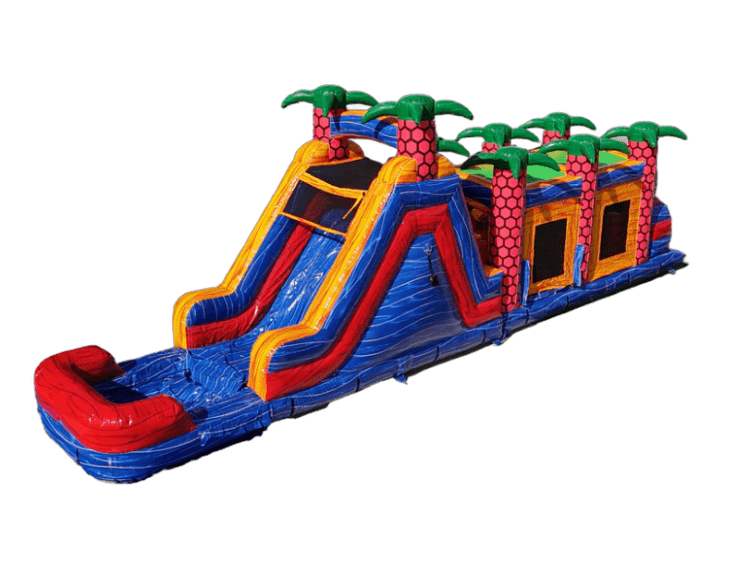
An obstacle course covers a long, narrow footprint rather than a square one, so the covered area is larger but the traffic is spread out instead of concentrated. Recovery is generally similar.
Do you set up on grass in my town?
We set up on lawns every weekend across Lafayette, Maurice, Youngsville, Broussard, Abbeville, Carencro, Breaux Bridge, and Scott. More answers are on our FAQs page.
Ready to Book Your Acadiana Party?
Your lawn will be fine, and your kids will remember the party for years. Whether you are planning a birthday party in Youngsville, a fall festival in Maurice, or a company picnic in Lafayette, we will help you pick a unit and a setup spot that works for your yard. Browse the full lineup and check your date on our booking page, or just call us at (337) 469-4669 and tell us about your yard. We are happy to talk through it before you reserve anything.
References
LSU AgCenter, Turfgrasses – St. Augustinegrass
Sports Turf Managers Association, How Long Can You Leave a Tarp on a Sports Field?