

How Many Bounce Houses Do You Need? A Multi-Unit Event Planning Guide for Acadiana
If you are planning a school fall festival, a church fun day, or a company picnic, one question tends to stall the whole plan: how many bounce houses do you need? One unit sounds simpler and cheaper. But anyone who has watched 150 kids form a single line at a carnival in Lafayette knows what comes next — a twenty-minute wait, a lot of restless kids, and one inflatable that only entertained a third of the crowd.
We deliver to events all over Acadiana — Youngsville, Broussard, Carencro, Scott, Abbeville, Breaux Bridge and right here at home in Maurice — and the difference between an event that flows and one that jams almost always comes down to unit count, not unit size. In this guide you will learn how to estimate how many bounce houses you need using real headcount and event length, how to zone your space by age, what a second or third unit changes for space, power, water and staffing, and when one well-chosen unit is genuinely enough.
Start With Throughput, Not Square Footage
The most common planning mistake is picking units by how impressive they look in the photo. What actually decides whether your event runs smoothly is throughput — how many kids can cycle through an attraction per hour.
Here is the arithmetic we walk customers through. A typical bounce house comfortably holds a handful of similar-sized jumpers at a time (our capacity guide breaks that down by unit). If you run ten-minute turns, that is six turns an hour. Six turns times six riders is roughly 36 kids per hour, per unit — and that is assuming a monitor keeps the rotation tight.
Now put your crowd against that number. One hundred and fifty kids at 36 per hour means more than four hours for every child to get a single turn. Kids do not come to a festival for one turn.
The Quick Formula
- Count the kids, not total attendance. At family events, adults make up a big share of the headcount and will not be jumping.
- Decide how many turns you want each child to get. Two is a realistic target.
- Multiply: kids × turns × 10 minutes = total unit-minutes you need.
- Divide by (event length in minutes × riders per turn) to get the number of units.
Example: 120 kids × 2 turns × 10 minutes = 2,400 unit-minutes. A three-hour event gives you 180 minutes × 6 riders = 1,080 unit-minutes per inflatable. 2,400 ÷ 1,080 ≈ 2.2. So you want three units — or two units plus a non-inflatable activity to absorb the overflow.
A Simple Starting Point for Acadiana Events
If you do not want to do the math, here is the shorthand we use when a school or church calls us in Lafayette or Breaux Bridge. These assume a two- to three-hour event:
- Under 30 kids — one unit is plenty. A backyard birthday almost never needs two.
- 30 to 75 kids — one large combo, or two smaller units if the ages are spread out.
- 75 to 150 kids — two to three units, ideally of different types.
- 150+ kids — three or more, plus games, food lines or other activities so the inflatables are not the only thing to do.
Zone by Age Before You Zone by Space
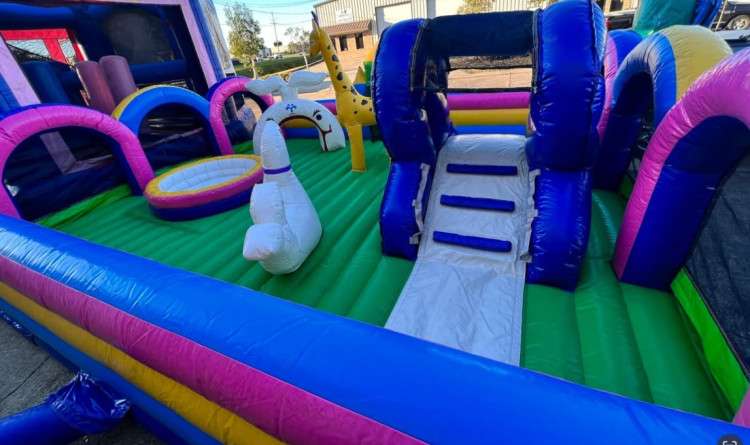
When you add a second unit, do not add a clone of the first one. Mixing a three-year-old in with ten-year-olds is the single most common source of bumped heads and tears at a big event — and it is completely avoidable.
The U.S. Consumer Product Safety Commission’s Public Playground Safety Handbook recommends separate play areas for preschool-age children (2 to 5) and school-age children (5 to 12), with a buffer zone in between — benches, cones, or simple distance — so older, faster kids are not running through the little ones’ space. The same logic applies to inflatables, and it is the reason we push age-zoned layouts at every school and church event we set up.
- Little-kids zone: a low toddler playland or a walled castle with no slide. Keep it near where parents are sitting.
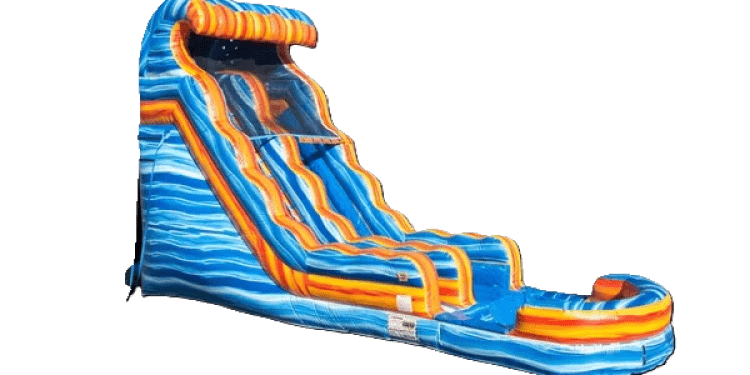
- Big-kids zone: an obstacle course or a tall water slide, set well away from the little ones.
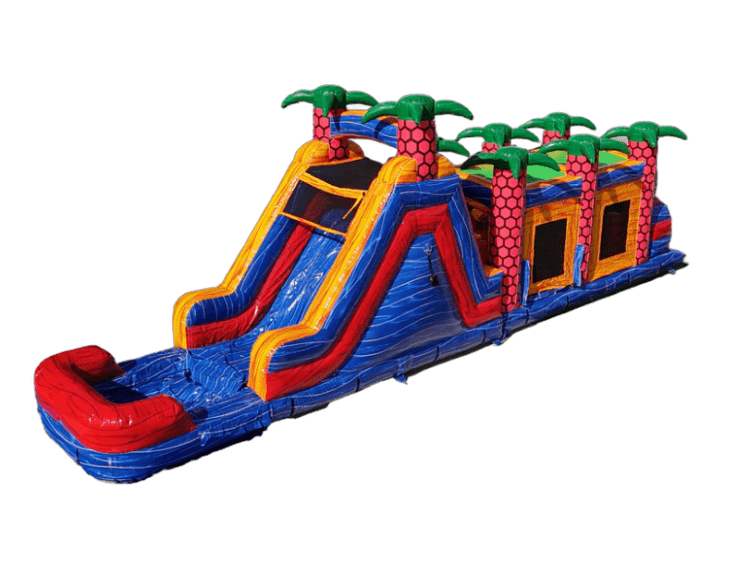
- Teens and adults: if your crowd skews older, an obstacle course races two at a time and keeps big kids busy without crowding a jump floor.
Two Smaller Units Usually Beat One Giant One
When the budget only stretches so far, event planners often ask whether they should put it all into one showpiece inflatable. At a large event, two units almost always outperform one:
- Two lines instead of one. A single line is where the complaints start.
- Real age separation. One unit cannot be both toddler-safe and teen-worthy.
- Redundancy. If wind or a wet spell forces one unit to shut down, your event still has something running.
- Easier placement. Two mid-sized footprints fit into an awkward field or lot far more easily than one enormous one.
The exception is a backyard birthday party. With 15 or 20 kids in one yard, a single bounce-and-slide combo gives you more play value than two small units and takes up half the space.
What Extra Units Change on Setup Day
Space and spacing
Every inflatable needs clear space on all sides — and when you put two side by side, you need walking room between them, not just clearance. Do not butt them together. Blowers, entry steps, exit ramps and waiting lines all need room, and a monitor should be able to walk the full perimeter of each unit. Plan a lane down the middle so parents can move between zones without cutting through a line.
Power
Each unit runs its own blower, and each blower wants its own circuit. Running two blowers off the same household circuit is a reliable way to trip a breaker mid-party. At a field or park where there is no dedicated power, plan on a generator sized for every blower you are running — and tell us your unit count in advance so we can advise on it.
Water
If you are running more than one wet unit, remember that hose pressure splits. At most events, one water slide plus one dry unit works far better than two slides sharing a single spigot.
Anchoring on ground you do not own
Units on grass are anchored with stakes driven into the ground. Before anyone drives stakes into a field, park or church lot, someone needs to know what is under it. Louisiana 811 is free to everyone, and Louisiana’s damage prevention law requires notice at least two full business days before digging. Call 811 or file a locate request online, and locators will mark underground lines before your event date. On pavement, we anchor with sandbags instead — see our guide to hard-surface setups.
Staffing: One Adult Per Unit, Every Minute It Is Running
This is the line item most committees forget. Every additional inflatable is an additional adult who has to stand there the entire event — not a volunteer who is also working the ticket table. That monitor enforces the rotation, keeps sizes matched, stops the shoes and the snacks at the door, and calls the shutdown if the weather turns.
Three units means three monitors, plus a floater for breaks. If you cannot staff four adults for the full window, book three units and run only two at a time, or book two units and lean on games. Our party games guide has low-cost ways to keep the waiting kids busy, and the rules-of-the-unit rundown is a good handout for your volunteers.
How the Budget Actually Scales
Adding a second unit is not simply double the cost of the first, because the delivery, setup and pickup are happening on the same trip to the same address. That is why a two- or three-unit event often lands better per child than the sticker price suggests. Give us a call at (337) 469-4669 and tell us your headcount, your date, and the age spread — we will build a multi-unit quote around the event rather than the equipment list.
If the budget is genuinely fixed, spend it on the right single unit and fill the rest of the schedule with free activities. One great combo plus organized games beats three mediocre rentals every time.
Booking Multiple Units: Start Earlier Than You Think
One bounce house on a random Saturday can sometimes be arranged on short notice. Three units on a Saturday in October cannot. Late August is exactly when Acadiana schools, PTOs, churches and businesses lock in fall dates, and the multi-unit Saturdays go first.
If you are planning a school event, a church event, or a corporate event this fall, get your date on the calendar now and refine the unit count later. It is far easier to adjust a booking than to find three available inflatables three weeks out. Our booking timeline guide walks through the lead times month by month.
Frequently Asked Questions
How many bounce houses do I need for 100 kids?
For a two- to three-hour event with about 100 children, plan on two to three units. Two will work if you also have games, food or other activities absorbing part of the crowd; three keeps the lines short if the inflatables are the main attraction.
Can you deliver more than one inflatable to the same event?
Yes. Multi-unit deliveries are routine for us across Acadiana. Tell us the unit count when you book so we can schedule the right crew and setup window.
Do I need a separate outlet for each bounce house?
Ideally, yes — each blower should be on its own circuit. Two blowers on one household circuit will often trip the breaker. At parks and open fields, plan on a generator sized for the total number of blowers.
How much space do two bounce houses need?
More than double one unit’s footprint, because you need clearance around each unit plus a walking lane between them. Measure your area and send us the dimensions — we will tell you honestly what fits.
Can we mix a bounce house and an obstacle course at the same event?
That is one of the best combinations there is. The bounce house serves the younger kids and the obstacle course gives older kids a race to run, which naturally splits your crowd into two lines.
What happens if it rains and we have three units booked?
The same weather policy applies whether you booked one unit or five. We monitor conditions and work with you on the call. See our rain policy guide for how we handle it.
Which Acadiana towns do you deliver multiple units to?
We serve Lafayette, Youngsville, Maurice, Broussard, Abbeville, Carencro, Breaux Bridge and Scott. See our Lafayette and Maurice service pages, or check the FAQs for delivery details.
Ready to Plan Your Multi-Unit Acadiana Event?
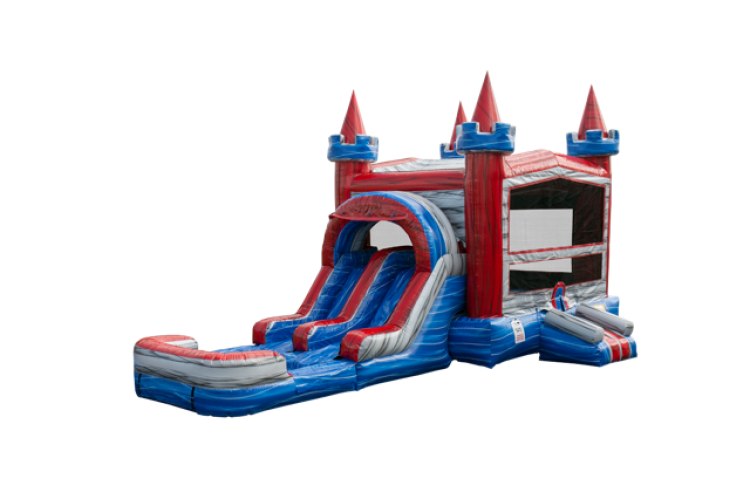
Tell us your headcount, your date and your age range, and we will tell you exactly how many units your crowd actually needs — even when the honest answer is “fewer than you think.” Browse the full bounce house, water slide and obstacle course lineup, then check availability and book online, or call Patriot Jumps at (337) 469-4669. We are based in Maurice and we deliver across Acadiana.
References
- U.S. Consumer Product Safety Commission — Public Playground Safety Handbook
- Louisiana 811 — free locate requests before driving stakes or digging